Showing posts with label board games. Show all posts

Thursday, March 7, 2013

How to make a Westeros Map - Pt.1

I'm a big fan of A Song of Ice and Fire, the book series upon which the TV series Game of Thrones is based (hell, I adore the show aswell and I can't say that about many book to film adaptations). They really got the casting right, didn't they? Anyway...

A while back I bought a copy of A Game of Thrones: The Board Game (2nd Ed.) and proceeded to play a few games with friends. After getting through the unnecessarily dense rule book I really love the game, it's tense and relies on strategy, teamwork, backstabbing and a little bit of luck. The game tokens, cards and other components are quite lovely and really do the the universe justice. But I really loved the board. I have a bit of a thing for fantasy maps, so with this in mind I decided that I would make a 3D Westeros map from scratch and really go to town on the detail. One could use the method in this guide to make a board that will suit almost all medieval/fantasy board games, though after mulling it over I've decided it'll be for decoration only. The amount of game related detail I'd have to add would ruin the aesthetic in my humble opinion, and this really is meant to be looked at rather than played on. That, and as I don't have to worry about it being a playable surface I don't have to worry about it being a functional piece. And now to the drawing board!


What you'll need


Before starting the build it pays to plan and figure out you'll is required. Here is what I used (power tools not pictured):

Map outline - I used the board game board to trace the outline of the map, but optionally you could get a printed copy of the map using an image from the internet (see the bottom of this post for some suitable links).

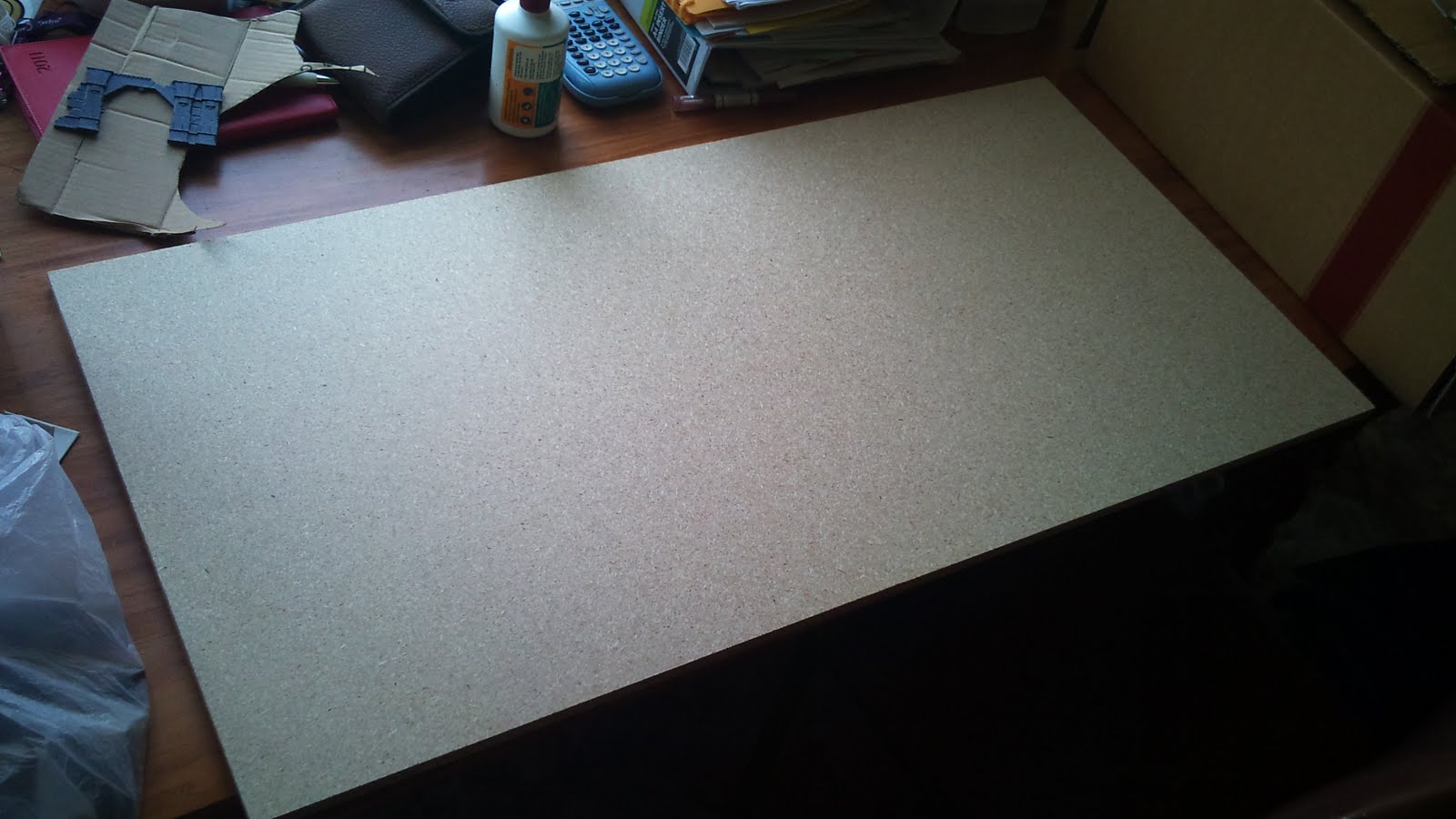
Backing board - You could use chipboard or MDF, but a piece of quality edge laminate board will be much more durable, be far less prone to warping and look far better.

Map/Detail board - This is what most of the board detail will be made from. As this will be painted and detailed it doesn't matter what it looks like, so I used 6mm (1/4") MDF as it's easy to cut and shape, plus it adheres well to the backing board.

Tracing pad - A3 or bigger.

Pencils and a couple of fine tipped permanent markers - For tracing and map layout.

Brushes - I used about 6-7 making this board, ranging from a 0 fine tip miniature brush to a 3" gloss brush.


Paints - Make sure they're water based. I used Citadel paints and a commercial brand gloss.

Spray undercoat - I used Citadel Chaos Black, though any matt black water based paint should do.

Wood file/Dremel - I used a fine/med grade 1" flat file and a Dremel with assorted pieces.

Scalpel and/or Scissors - I used both.

Filler - I'm using Builders Bog, but you can use any fine, durable filler. Car filler (bog/bondo) is also suitable, though the tougher the filler the better as it will be subject to more than a few dings with regular play.

PVA Glue - Always good to have some on hand.

Sandpaper - I used a few sheets of 80 and 120 grit sandpaper.

Jigsaw/Router/Coping Saw - I used a jigsaw and router (not pictured) to shape my board, though a coping saw and file will do the job. That said a jigsaw and router make life much, much easier though they are both dangerous tools and as such you should know what you're doing with them lest you hurt yourself. I can't state this loudly enough - power tools are dangerous, especially routers and saws, and as such be sure to wear the appropriate safety equipment whilst using them.

Moulded Trim and Brass Hardware (optional) - When the board is complete I want to protect the edges and frame it nicely, so I'm using 28mm moulded hardwood trim, brass nails and brass corners with brass tacks. This is entirely optional but I recommend it as it looks great and evens out the edges to give it a uniform, professional aesthetic.


Making the board

Step 1 - Tracing and cutting out the map

This is a seemingly simple step but know that it is fiddly, precise and time consuming. As you can see in the image below, I needed to use three sheets of tracing paper to trace the board in full. I used a pencil to do the tracing and a scalpel and pair of scissors to cut out the shape. This step is fairly easy but I will state this - take your time, do it once and do it well. If you make a mistake you will not be a happy individual.

N.B. - I have cut out all the islands around Westeros and put them aside, as they'll be added later. The process is the same as the map except on a smaller scale.


Left: The three pieces of tracing paper, ready to be traced on. Right: Traced and cut out carefully.  

Once that's done it's time to get a print of it on the map/detail board (6mm MDF, in this case). Be sure to put blu-tack/tape in the middle of each piece of tracing paper to keep it still, and spray from the middle of the paper to the outside and not the other way around (as you'll blow the tracing paper away). Also, keep the used pieces of tracing paper as you might want to use them again (and believe me, you won't want to trace the map again!).


Above: The tracing paper before and after being used as a spray stencil.


Step 2 - Cutting, shaping and putting it all together.

As with tracing the map this might seem to be a fairly easy task, but again it is fiddly, time consuming and it is very easy to make a mistake (and even harder to correct it). Once again take your time, do it once and do it accurately.


Above: Rough map cut out using the jigsaw, after which I used a router and jigsaw to cut out the detail. The edges will be rough after being cut, so be sure to use sandpaper to tidy them up.


Below Left: The complete map cutout and backing board.   Below Right: Placing the moulding against the board's edge I aligned the top of the map to it to make sure than when it's finished it all fits flush together.


Above: Though the glue would've been more than enough to hold the map to the backing board I used a dozen 1" tacks to hold the map in place. This also ensures the map doesn't move accidentally because once the glue is dry you'd destroy it before you're able to adjust its position.


Below Left: I used a two part epoxy glue to adhere the map cutout to the backing board. Make sure you sand wood surfaces thoroughly before you apply the glue, and be sure to apply it evenly and give it plenty of time to set (I left it overnight).   Below Right: The finished board, ready for detailing. The islands were rather fiddly to get right but they look great.


Step 3 - Preparing the board for detail.

I used a couple of permanent markers to outline the features of Westeros on the board before adding detail to make sure everything was laid out correctly. Lucky for me a short way into the build I was given a set of maps of the entire Song of Ice and Fire world by some close friends for my birthday (thanks again Kendall and Dan!) so I had great reference material to work with, but if you were to jump on Google you'd find a number of great maps to use (I've put links to a couple of good ones at the bottom of this post). I recommend you colour code the features so that you don't mistake a river for the edge of a mountain range (or vice-versa), and double check everything before proceeding. 


Above: The completed blank board, ready for detail.

Check out part 2 to see how to add detail, paint the board and apply the finishing touches.


Westeros Map Links:

http://gameofthrones.net/images/Westeros_Maps/map_of_westeros.jpg
http://barbariana.com/wp-content/uploads/2011/11/Map2-2_Map_of_Westeros_Original.jpg
The 'Where's Waldo' Westeros Map (warning: big [!] file) - http://www.fanboy.com/wp-content/uploads/2011/07/Westeros.jpg

Sunday, January 30, 2011

Making your own Terrain Boards - Update

Following on from the Terrain Board tutorials I thought I'd show you yet another that I've made. This one has a bit more detail - a corpse bereft of flesh, a bloody sacrificial altar and some pikes for good measure.

The method I use to make larger hills and the like involves cutting up many pieces of thick cardboard into a manageable size (100 x 50mm [4" x 2"] roughly), slathering them in PVA and putting them together in a 'lattice' layout. Layering them in this manner makes for flexibility, strength (basic engineering at work here) and simplicity. You could just cut out the cardboard in the shape of the hill and layer them that way but I find that this method is faster, easier, stronger and uses less card. It's entirely up to you though.


Below: This shows the layers of the hill being glued in place. Add layer upon layer until you're happy and make sure that you use plenty of glue and give it time to dry (overnight is perfect). Oh and yes, that is a big (real!) rock on one end of the hill. I only used PVA and a little filler to hold it in place, simple.


Below: To get a nice finish on top I put a large piece of card. This isn't necessary but I wanted a nice, smooth platform which only needed a skim coat of filler.


Below:
An example of what happens when you put on filler too thick. You can fix this fairly easily by putting on a skim coat to fill the cracks but try to avoid it where possible as it can make it more prone to dislodge and flake off.


Below: The completed boards, all ready to be undercoated. Remember to give your boards plenty of time to dry before undercoating.


Below: The pikes were made from bamboo skewers and the altar is a piece of balsa wood cut, slashed and chipped randomly (using a modelling knife) with a Chaos standard taken from my bits box (which was also cut/slashed with the knife).

SAFETY NOTE: Be careful when using a modelling knife and make sure you're cutting AWAY from yourself, where possible cutting on to a chopping board, modelling mat, used thick magazine or similar. You're going to cut yourself eventually - the skill is in making sure you don't cut yourself seriously.


Below:
The undercoated board, ready to go.


Below: The completed board ready to have detail added. The skeleton was painted using Bleached Bone and final highlights of white.


Below: All done. The skeleton had some Chestnut/Flesh wash applied, supplemented by a few select splotches of a mix of Blood Red, Crimson and Chestnut wash highlighted with straight Blood Red. To get the clotted blood effect on the altar I applied the same mix really thick and applied a couple of coats, making sure there was enough to form a couple of drips. The Chaos symbol on the rock used the same mix again with a touch of Purple to give it a magic/surreal effect.


Below: I painted some foot/knee/hand prints on the right to show someone who tried to get away whilst bleeding heavily.


Again this board cost less than $10 to make (excluding the skeleton and Chaos symbol).

Cheers!

Saturday, January 29, 2011

Make your own Steampunk Nerf Maverick and CS-6 Guns (also known as 'A lapse in concentration')

Though not technically related to this blog I felt that I should add this, safe in the knowledge you will approve of such deviant content.

For those of you who are not aware, 'Nerf' is a Hasbro brand (to which I am in no way affiliated) of wonderfully pointless toys designed to allow children and adult-children (henceforth known as childults) to shoot one another with foam darts. Being that I'm a childult I was compelled to purchase one for both myself and my partner who was almost more excited than I was to have her very own Nerf pistol.

After getting home and wrestling our respective Nerf guns from their boxes, a half hour skirmish ensued - adult chasing adult with scant regard for knick-knack, item of memorabilia or tumbler glass. Later reflecting upon our chase we determined that it was much fun, 'But wouldn't it be cooler if they made Steampunk Nerf guns?' crooned my out-of-breath significant other. Turning to meet her enthusiastic smile I made an astonishing discovery: that Steampunk Nerf guns would be awesome, and how good was I for having thought of them? With this in mind I told her that 'I will make for us now Steampunk Nerf guns, so that we may use them and smile!'. Hence from that place I went and traversed the arduous space between the couch and the fridge, after which my machinations took shape once I'd polished off some delicious Sprunk. Ahem...

First thing is you start with a Nerf gun (or more as the case may be). You then have to take them apart so that you can see where you have to spray.


When spraying (I used Citadel Chaos Black spray) make sure that you get in all the nooks and crannies but not on any slides/frictive surfaces. This means spraying a single coat and then pulling everything back and spraying it, being sure to get every square inch. Leave them to dry for a couple of hours on a hook/peg/washing line/narcoleptic sloth.


Once they're dry the plan is to drybrush them (see my Terrain Boards Pt 4 tutorial for a guide). I used a rather large brush (about 1" [25mm] across), making it much faster to complete than you might think (a couple of hours it took me). I used a 'Tinbitz' metallic (I think) to paint the body, 'Chainmail' metallic to paint the barrels/detail and 'Burnished Gold' metallic for writing/crests. I built up a few layers of drybrushing and it turned out really nicely (just make sure you drybrush in all the corners [there are many]).

Here is a pic after the first round of drybrushing


The finished beasties (that said I'd like to add some brass engraved plates, copper tubes etc. but I wanted to make sure they still worked well and weren't just ornaments):


I couldn't help it...


I'd like to Steampunk some more items but with 1001 projects on my hands we'll see how that goes. Please feel free to comment and suggest Steampunk'able items or to add links to other cool Steampunk stuff, like this.

PLEASE NOTE: In no way do I endorse nor take responsiblity for any mods you make to any 'Nerf' brand foam projectile launchers and so on and so forth. On the side of each toy it says 'Do not modify darts or dart blaster'. You have been warned. Oh, and apparently if you live in the USA you should make sure that the tip of the barrel remains bright orange - something to do with legalities and safety etc. But then you wouldn't modify a 'Nerf' dart blaster, would you?

Cheers!

Tuesday, January 18, 2011

Terrain Boards Pt 1 - Getting started


Introduction


So you've spent a tonne of time painting an army, hundreds of dollars of miniatures that have been painted and are resplendent with detail. It stands to reason that you should have a lovely battlefield upon which to wage a holy war or a bloodthirsty onslaught. Terrain and games boards are underrated, they really add detail and interest - you've spent so long building and painting a host, it makes sense that they get to play on a sweet battlefield.

There are many methods available to make terrain suitable for tabletop gaming which, depending upon the application, can be great to look at but not easy to work with, or good to work on and look at but very expensive and inflexible. With this in mind the method proposed in this tutorial is based around price, flexibility, simplicity and good aesthetic.


What you'll need

The great thing about this method is the average price, depending on how much you want to spend you can have each game board for around $10. The examples shown in this tutorial were cheap as chips and look great (in my humble opinion). Anyway, back to what you'll need:

PVA Glue (don't buy PVA from specialist suppliers, get the stuff from your local hardware store [they're exactly the same])
Chipboard sheets (the size depends on what you want, the ones used in this tutorial [900 x 450 x 12mm {3' x 1.5' x 1/2"}] are available from most hardware stores pre cut and can be arranged together to make larger boards easily)
A larger, used paintbrush
Plaster or Filler (cheap wood filler is great, tough, fast setting and easily mouldable)
Rocks and/or Gravel
Lots of Cardboard (different thicknesses are handy)
Paint
Newspaper (put it under boards you're working on to protect furniture and floors from glue, plaster, paint and the inevitable crud that comes with terrain making)
Stanley/Modelling Knife and Scissors(kitchen shears are the best)
Undercoat spray paint (make sure it's matt spray, not gloss)
Flock, polystyrene, static grass, barrels, walls, barricades or anything else you'd like to add


Getting started

First of all you should have a good work area that isn't in the way and try to make sure it has good circulation (all the different things you'll be using tend to smell when they dry, it's always good to have fresh air when working with glues/paints/solvents etc.). You'll also need somewhere outside that you can spray undercoat each of the boards and you'll need to leave them there to dry.


Once you've set up your work area you can get started. There are a few things you should keep in mind when making your boards -

Storage - How and where are you going to store them? Do you have enough room?

Size - How big do you want them to be, how many will you have, what configurations might you use?

Height
- This relates to storage and strength, if you make tall boards they'll be hard to stack on smaller/tighter shelves. Taller terrain will also break more easily, so its better to make tall terrain items separately (this also aids in flexibility re: desired placement on the battlefield).

Tightness of terrain
- How close do you want difficult ground to be together? Too close and it could makes bigger games difficult, for my boards I've put them mostly in the corners and have limited them to one terrain item per board (this means you can turn them around to make central areas with lots of terrain, evenly dispersed terrain items or a wide plain/valley for bigger pitched battles).

Theme
- Boards tend to go together in themed sets, i.e. one particular style of terrain and colour scheme for each set of boards. With this in mind you should choose what style you want before you begin and perhaps try making a small terrain item (a hill, rocky cairn etc.) in said style to see if you like it. The ones in this tutorial are old, bluish, stony battlegrounds with tufts of life clinging to what little arable soil there is. You could do something similar or completely different - lush green pastures with hedgerows, a marsh with rushes and waterlife, snowy drifts criss crossed with lava streams, the mortar scarred remains of a distant planet, a barren desert...the only limit is your imagination.

When you've get everything you need and a place to work you can start Part 2 and begin putting it all together.

Terrain Boards Pt 2 - Laying the foundations

Laying the Foundations

You can buy ruins and the like from game suppliers but they're usually only a couple of millimetres thick, expensive and need to be based and painted anyway. Using cardboard and old packaging (which is easy to find and plentiful) you can make almost anything for next to nothing. You're also doing the environment a favour by recycling materials rather than using new plastic ones, though adding bought items is easy and can add items of interest to your board.


Now that you've got your work area set up you can cut your cardboard to make any shape. The board made in this tutorial has a crumbled tower made from cardboard, gravel and an old terrain wall that I had lying around. There is also a low stone wall (made from gravel) and some reeds surrounded by rocks (made from some broom bristles and gravel). When you're putting together all these items make sure that you use plenty of PVA, make sure it fills all the cracks and give it a while to set in place (a couple of hours or so in a warm room will do). This ensures that everything sticks like proverbial and therefore, hopefully, nothing will fall off and your boards will survive a few knocks. Just make sure that there isn't a tonne of PVA in blobs (unless this is a deliberate measure, blobs and drips of PVA make for great blood/alien goo etc.), it's quite noticeable in the final product (unless you go over it with plaster/filler, but try to avoid having to rely on fixing mistakes by covering over them).


This is what my crumbled tower and rock wall looked like about 15 minutes after everything was in place.


Note liberal use of PVA. You'll find it'll stick better if you 'rub' the two pieces of cardboard together, ensuring an even and complete cover of glue. Also, try to glue rocks to more than one thing, they're heavier and the more glued contact points the stronger the bond will be. If you want to have any items of interest that look submerged (half a tank, a skeleton, half buried armour, pikes/spears etc.) now is a good time. If you want to make a wooden pole fence you can drill a few shallow holes for your 'fence posts' (I use bamboo skewers) then glue and slot them in, the same goes for pikes coming out of the ground (having a shallow hole [4-5mm or 1/5"] also helps them to stay in play far better than if you only glue them to the surface).


These are the reeds surrounded by rocks. Just make sure you use an old broom/brush for this as cutting into your wife/girlfriend/Mum/Dad/housemate's new broom could be physically perilous.


The layout of the board.


Some time later...

Now that all the glue is dry this is what it looks like. Once it's all dry you can move on to applying filler/plaster.


After a couple of hours you can commence with Part 3, Getting some texture.

Terrain Boards Pt 3 - Getting some texture

Getting some texture

Now that the everything is set in place you can apply filler/plaster to give everything texture, cover over mistakes and provide extra adhesion. When buying your filler/plaster try to go for the bigger, cheaper wood fillers. They tend to be much stronger than plaster and once dry go quite hard, not to mention that filler tends to take on shapes easier than plaster due to it's thicker consistency. You'll also use quite a lot of it - for three boards (the three shown at the end of this tutorial) I used an entire tube, which cost about $12.

Anyway, to apply the filler just use pieces of thick, stiff cut cardboard (I cut mine around 150 x 90mm [5" x 3"]). You'll need plenty of applicators so cut a few for each board you're going to do. Squeeze out of the tube and straight on to the applicator and then use the applicator like a spatula - work the filler into the board and the cardboard, filling every crack. This will make it stick all the better and add further strength to each structure. Once you've done this you can use an applicator, or anything for that matter, to give texture to the surface. You could stipple the surface, drag lightly along it, stab it with skewers, mould it into shapes - the choice is yours.

NOTE: Be careful not to make the filler structural or too thick, use cardboard and other items to build shapes and then use the filler to give it texture. Try not to make filler/plaster more than 8mm (1/3") thick.


WARNING: If you've used polystyrene ('foam') to make any of this terrain be sure to make sure that it's completely covered in filler. Spray paints usually eat/melt this foam but as long as it has a layer of something over it it'll be fine. You were warned!

Here is how the board looked after I'd applied some filler. It's great stuff to use and dries hard, leaving a good surface to play on. After applying the filler leave it overnight to dry, you want to make sure that it's fully set before you work with it.


To get this effect on the filler I dragged an applicator along the surface, giving a flat surface with gaps between that look like eroded stone. You can apply all manner of different textures using household items (sponges, skewers, spatulas, modelling tools and anything with an interesting texture are all recommended) and the filler usually cleans off pretty easily with some water.


You can see that I've also smeared random filler across parts of the board. This helps to give some extra texture to the board and helps it to look more 3D, rather than just being flat. You can use cardboard to put up gentle hills and slightly raised ground, then use filler to make it smoother and more realistic later aswell, if you like.


Once the filler has set you can add an extra layer of filler if you need to, again make sure that you work it in to the surface so that it sticks well and don't make it too thick. It's better to have fairly thin layers and use more cardboard (as it's free, light and should form the bulk of any structure/hill/raised structure).

Another thing you might like to do is paint parts of the board with PVA and then pour sand on them. This is another great way to give the board/terrain items texture and is super cheap (go to the beach and take a small plastic container, simple). Something else you can do is mix different grades (re: size and texture) of sand/gravel together and pour them onto the glue at the same time - this makes for a more random sort of texture (I'll show you this method in a future tutorial).

When you're ready you can move on to Part 4, Adding some colour.